
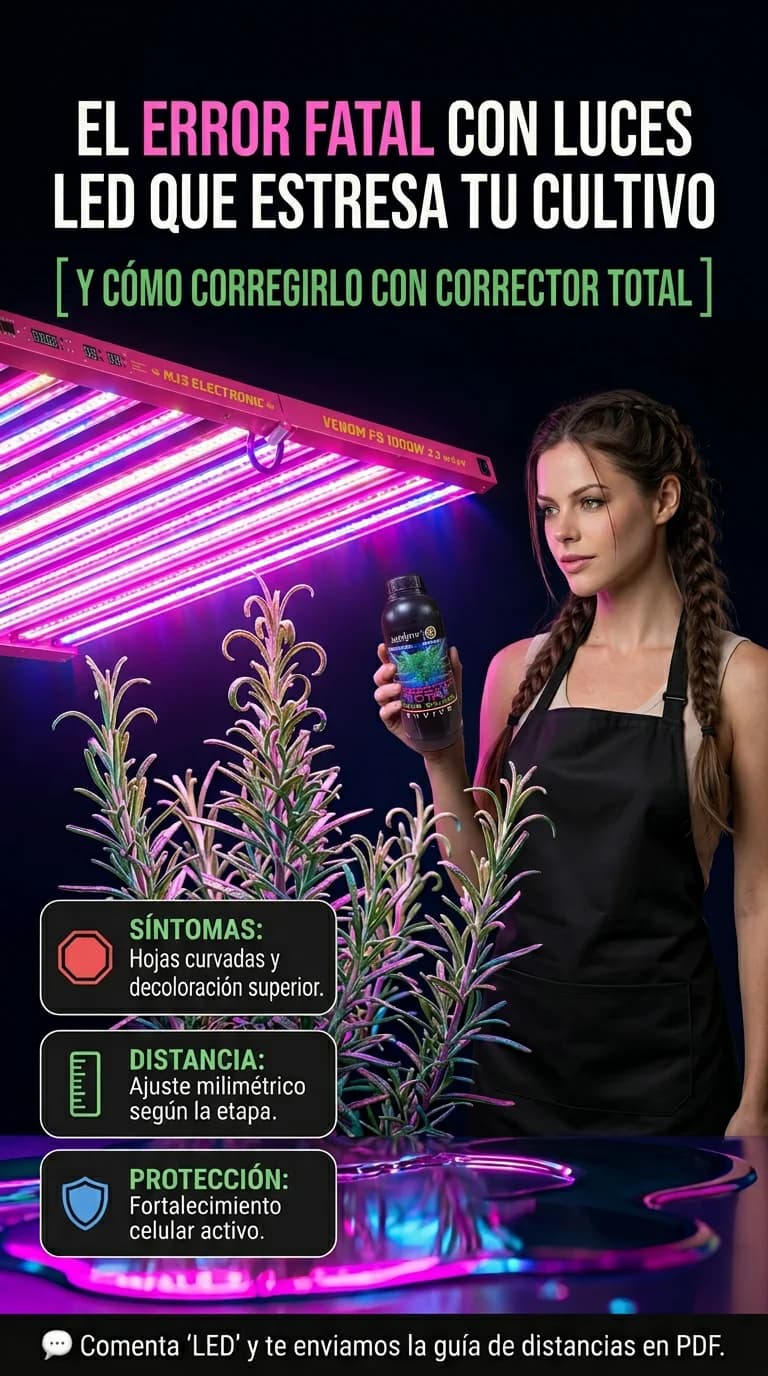
Top 5 Common Mistakes in Using LED Lights and How to Fix Them to Avoid Light Stress
The article identifies the five most common mistakes in using LED lights for indoor cultivation, which can cause light stress and affect plant growth. It offers practical solutions to correct these issues and keep plants healthy and productive.
Top 5 Common Mistakes in Using LED Lights and How to Fix Them to Avoid Light Stress
LED lighting has revolutionized indoor cultivation, offering energy efficiency and customized spectrums for each stage of plant development. However, their power and precision can also become a double-edged sword if not handled correctly. Light stress —that silent enemy causing yellowing leaves, stunted growth, or even burns— is one of the most frequent causes of yield loss in LED-grown crops.
In this article, we break down the 5 most common mistakes in using LED lights and give you practical solutions to keep your plants healthy and productive. Because, as you well know, a stressed plant not only grows less but becomes more vulnerable to pests and diseases.
1. Incorrect Distance Between Light and Canopy
The mistake: Placing LED panels too close or too far from the plant canopy. With current LED technology, especially in high-power models like those from the [product:panel-led-spectrum-x] series, light intensity can be overwhelming at short distances.
The correction: Each manufacturer specifies an optimal distance (generally between 30 and 60 cm during flowering). Use a PPFD (photosynthetic photon flux density) meter to adjust the height. For seedlings, aim for 150-300 µmol/m²/s; in vegetative stage, 300-600; and in flowering, 600-900. If you notice leaf edges curling upward or white spots appearing, raise the light immediately.
2. Ignoring Photoperiod and Dark Cycles
The mistake: Leaving lights on for 24 hours straight, thinking more light equals more growth. Plants, like living beings, need metabolic rest.
The correction: Respect natural photoperiods. For photoperiodic plants: 18/6 in vegetative (18 hours light, 6 darkness) and 12/12 in flowering. Autoflowering plants can tolerate 20/4, but never less than 4 hours of absolute darkness. During the night, the plant carries out critical processes such as sugar translocation and CO₂ fixation. An erratic cycle can trigger light stress and flowering delays.
3. Using an Inadequate Spectrum for the Growth Stage
The mistake: Keeping the same light spectrum from seedling to harvest. Although full spectrum LEDs are versatile, not all offer the same ratio of blue (for vegetative growth) and red (for flowering).
The correction: Adjust the spectrum according to the stage. In vegetative, prioritize blue light (400-500 nm) to avoid stretching and promote dense leaves. In flowering, increase red (620-700 nm) and far-red (730 nm) to stimulate flower production. Panels like [product:led-full-spectrum-pro] allow independent channel control. If your light is not adjustable, simply change the distance or supplement with specific LED strips for the phase.
4. Not Measuring Light Intensity or Uniformity
The mistake: Relying solely on the panel's nominal power (watts). A 300W LED does not guarantee homogeneous distribution across the entire growing area. Peripheral zones may receive 40% less light than the center.
The correction: Invest in a portable PPFD meter. Measure at least 9 points in your growing area (a 3x3 grid). Aim for a maximum variation of 20% between the brightest and darkest points. If you detect low-intensity zones, redistribute your plants or add side reflectors. Remember that low EC (electrical conductivity) combined with low light can cause deficiencies, while high EC with intense light leads to over-fertilization.
5. Neglecting Temperature and Relative Humidity Under LED
The mistake: Assuming LEDs don't generate heat and therefore you don't need climate control. Although they emit less heat than HPS, high-power LED panels do raise canopy temperature, especially in dense crops.
The correction: Monitor temperature at canopy level (not just in the room). Under LEDs, plants transpire less, so relative humidity should be slightly higher (60-70% in vegetative, 40-50% in flowering) to avoid water stress. If temperature exceeds 28°C, increase ventilation or reduce light intensity. An overly dry environment with intense light causes stomatal closure and growth arrest.
Conclusion
Light stress is not a mystery: it is the consequence of small oversights that, accumulated, can ruin a harvest. The key lies in constant observation and adjusting three variables: distance, spectrum, and photoperiod. Remember that each plant responds uniquely; what works for one variety may not work for another.
Before modifying your setup, always measure the EC and pH of your nutrient solution (remember that for coco coir cultivation, the ideal pH ranges between 5.5 and 6.2). A nutritional imbalance can be confused with light stress symptoms.
With these 5 adjustments, your plants will stop suffering.
More articles
Complete guide to pH and EC in cannabis cultivation: How to calibrate, measure, and adjust without harming your plants
How to Read pH and EC in Substrate: A Practical Guide to Preventing Nutrient Lockouts in Indoor and Outdoor Growing
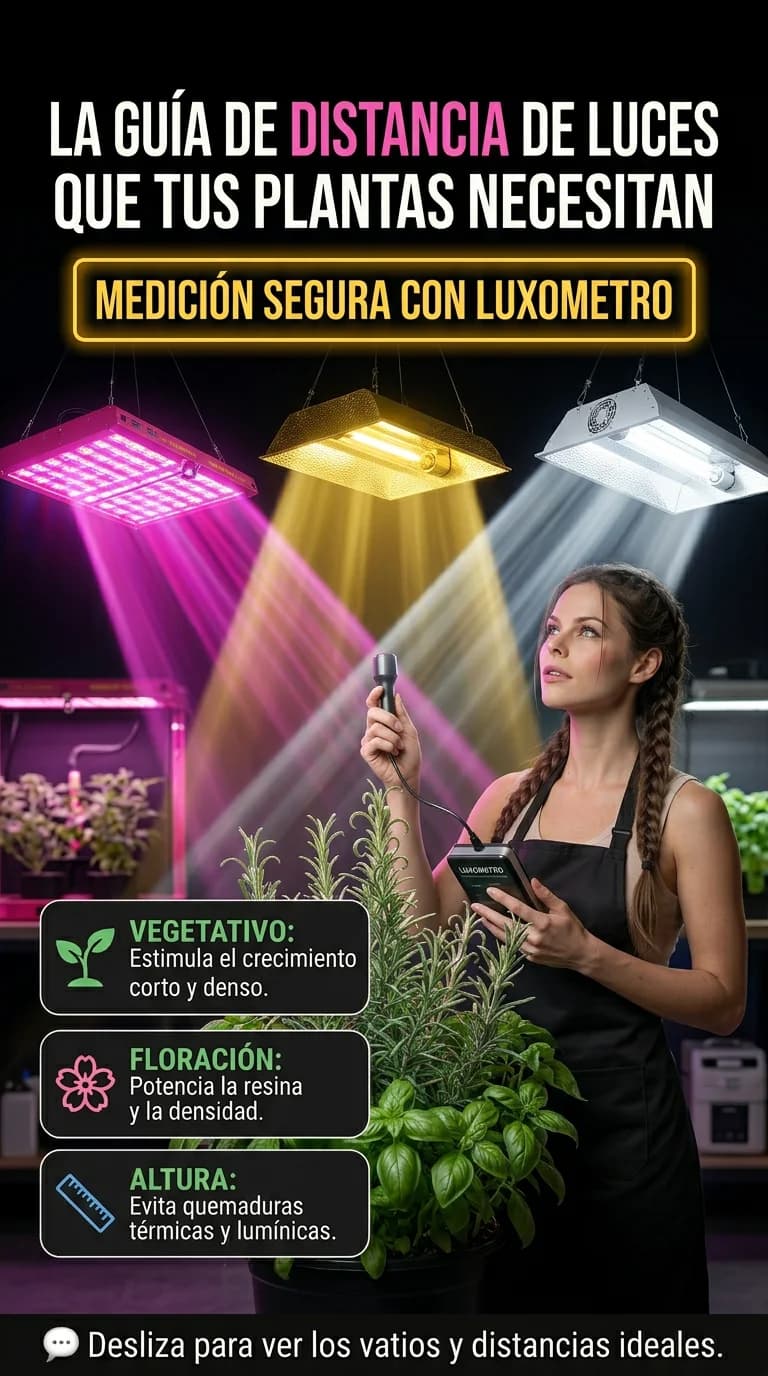
Ideal light and distance for each stage: How to avoid light stress and maximize photosynthesis with LED, HPS, and CMH