

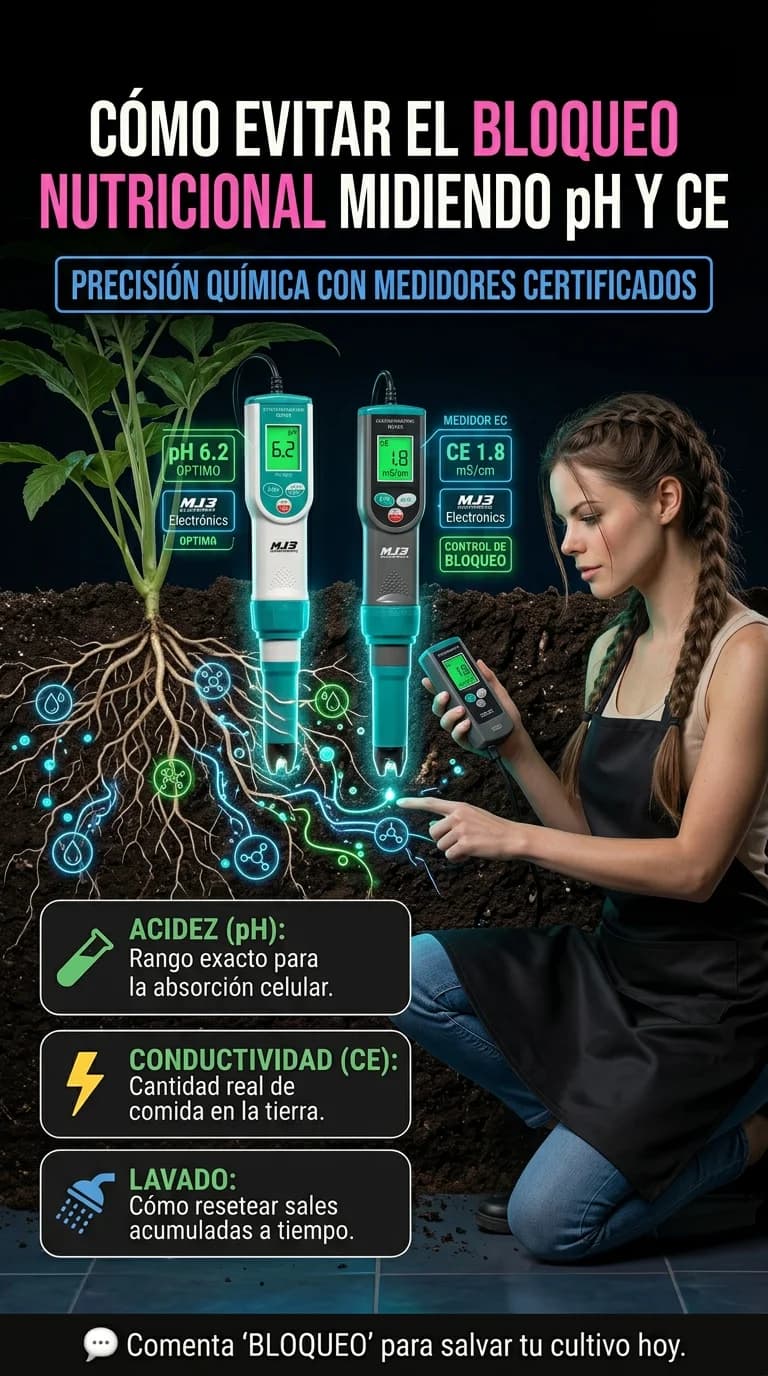
How to Read pH and EC in Substrate: A Practical Guide to Preventing Nutrient Lockouts in Indoor and Outdoor Growing
The article explains how to measure and interpret pH and EC in the substrate to prevent nutrient lockout in indoor and outdoor crops. Learning to read these parameters is key to maintaining optimal nutrient absorption and preventing issues like yellow leaves or stunted growth.
How to Read pH and EC in Substrate: A Practical Guide to Preventing Nutrient Lockouts in Indoor and Outdoor Growing
One of the most common mistakes among novice and experienced growers alike is relying solely on their eyes to diagnose problems. When leaves turn yellow, brown spots appear, or growth stalls, the cause is usually underground: a nutrient lockout caused by imbalanced pH or EC. Learning to read these two parameters in substrate is the difference between harvesting healthy buds or losing weeks of work.
In this practical guide, we explain how to measure, interpret, and correct pH and EC in your pots, whether you grow indoors or outdoors, to keep your plants always at their optimal absorption point.
What Are pH and EC and Why Are They Critical in Substrate?
pH measures the acidity or alkalinity of the substrate solution. In cannabis cultivation, the ideal range for absorbing all nutrients is between 6.0 and 6.8 in soil, and between 5.8 and 6.2 in light substrates like coco coir or perlite mixes. Outside this range, certain elements like iron, calcium, or phosphorus become insoluble, and the plant cannot access them, even if they are present in the watering.
EC (Electrical Conductivity) indicates the amount of dissolved salts in the solution, i.e., the concentration of fertilizers. An EC that is too high burns the roots; one that is too low causes deficiencies. In substrate, recommended values range between 0.8 and 1.8 mS/cm during growth, and between 1.5 and 2.5 mS/cm during flowering, depending on genetics and substrate type.
How to Correctly Measure pH and EC in Substrate
It is not enough to measure the irrigation water. Substrate accumulates salts and modifies pH over time. For a reliable reading:
- Runoff Method: Water your pots until 10-20% of water comes out of the drainage holes. Collect that liquid in a clean cup and measure with a calibrated digital meter.
- Saturated Paste Method (more precise): Take a substrate sample from the root zone, mix it with distilled water to form a paste, let it sit for 30 minutes, and measure the extracted liquid.
- Recommended Frequency: Measure at least once a week, always 24 hours after watering, when the substrate has stabilized its pH.
Important: If you only measure the input water, you don't know what is really happening at the roots. The runoff gives you the real picture.
Signs of Nutrient Lockout and How to Correct It
When the substrate pH deviates from the optimal range, specific symptoms appear:
- pH below 5.8 (acidic): Lockout of calcium, magnesium, and molybdenum. Deformed new leaves, burnt tips, stunted growth.
- pH above 6.8 (alkaline): Lockout of iron, manganese, boron, and zinc. Interveinal chlorosis on young leaves, general yellowing.
Practical Solution:
- To raise the pH of the substrate (if it is too acidic), use an alkaline solution like [producto:PH + Anarkia81 — 1 L] or its [producto:PH + Anarkia81 — 5 L] format for larger grows. Apply in watering at a rate of 0.5-1 ml/L until reaching the desired pH.
- To lower the pH (if it is too alkaline), use a concentrated acid corrector like [producto:PH - Anarkia81 — 1 L]. Add drop by drop until adjusted.
If visible lockout symptoms are already present, adjusting the pH is not enough. You need a specific treatment. [producto:Anarkia81 Corrector Total Todo en Uno — 1 L] is formulated to reverse deficiencies, chlorosis, and nutritional stress, especially in LED grows where lockouts are more frequent due to the intense light spectrum. For large gardens, the [producto:Anarkia81 Corrector Total Todo en Uno — 5 L] format is more economical.
How to Manage EC to Avoid Over-Fertilization
Substrate EC tends to rise over time due to salt buildup. To avoid this:
- Always water with 10-20% runoff. This flushes out excess salts.
- Alternate waterings with plain water (no fertilizers) once a week to leach the substrate.
- Measure the runoff EC: If it exceeds 3.0 mS/cm, stop fertilizing and apply a root flush with pH-adjusted water (6.0-6.2) until the output EC drops to 1.5-2.0 mS/cm.
- Outdoors, rain can drastically alter EC. After a storm, measure the runoff and adjust fertilization.
Quick Reference Table for Substrate
| Parameter | Optimal Range in Substrate | Action if Outside |
|---|---|---|
| pH (runoff) | 6.0 – 6.8 | Use PH+ or PH- to adjust |
| EC (runoff) in growth | 0.8 – 1.8 mS/cm | Reduce fertilizer if high; increase if low |
| EC (runoff) in flowering | 1.5 – 2.5 mS/cm | Flush if above 3.0 mS/cm; increase feed if below 1.0 mS/cm |
More articles

Complete guide to pH and EC in cannabis cultivation: How to calibrate, measure, and adjust without harming your plants

Ideal light and distance for each stage: How to avoid light stress and maximize photosynthesis with LED, HPS, and CMH

Pruning and LST Without Fear: Low-Stress Techniques to Increase Production in Small Spaces