

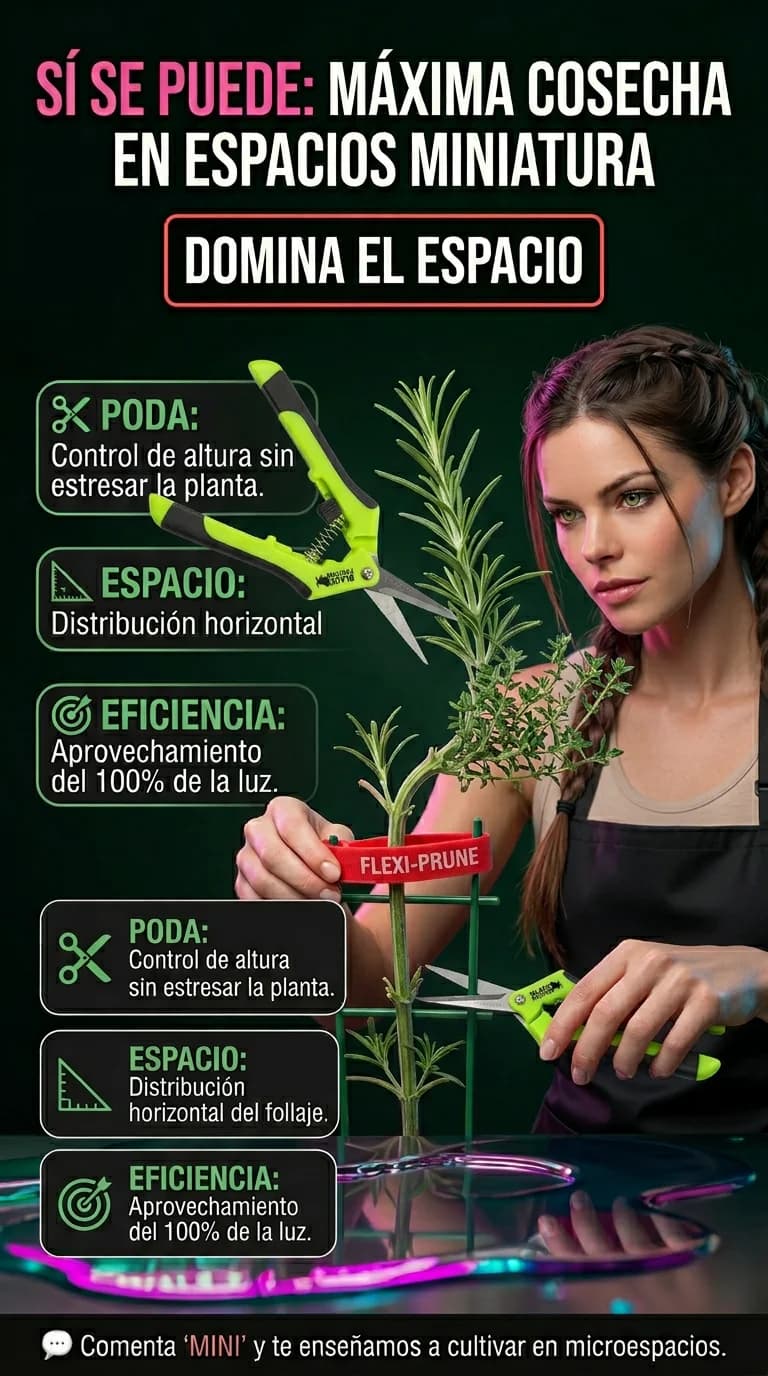
Pruning and LST Without Fear: Low-Stress Techniques to Increase Production in Small Spaces
The article explains how to apply low-stress techniques such as LST and gentle pruning to maximize cannabis production in small spaces, minimizing risks to the plants. These practices allow growers to make the most of every inch of cultivation and achieve abundant harvests even in cabinets or small rooms.
Pruning and LST Without Fear: Low-Stress Techniques to Increase Production in Small Spaces
Growing cannabis in small spaces presents a constant challenge for growers: maximizing yield without compromising plant health. In environments like grow tents or small rooms, every square centimeter counts. Fortunately, there are low-stress techniques that allow you to significantly increase production without subjecting plants to the risks of aggressive methods. In this article, we will demystify LST (Low Stress Training) and gentle pruning, explaining how to apply them correctly to obtain abundant harvests even in the most limited spaces.
Why Bet on Low-Stress Techniques?
Low-stress techniques are based on manipulating the plant's architecture without causing traumatic damage. Unlike methods such as topping or supercropping —which involve severe cuts or pinches— LST and light pruning work with the natural plasticity of Cannabis sativa. The key is understanding that the plant responds to mechanical stimulus by redistributing growth hormones, specifically auxins, which concentrate in the apical shoots. By gently bending or tying the main stem, we break apical dominance and force energy to be directed toward the lateral branches, creating a wider, more uniform canopy.
In small spaces, this technique is especially valuable because it allows you to keep plants low and compact, making the most of the available height. Additionally, by avoiding open wounds, we drastically reduce the risk of fungal or bacterial infections, a critical factor when ventilation and humidity are difficult to control.
LST Step by Step: How to Tame Your Plant Without Hurting It
LST (Low Stress Training) is the star technique for growers with little space. It consists of gently bending the main stem and lateral branches, securing them with ties so they grow horizontally. Here's how to do it correctly:
- Material preparation: You will need rubber-coated wire, adjustable zip ties, or soft garden twine. Avoid materials that could cut the stem.
- Ideal timing: Start when the plant has 4-5 visible nodes, usually in the third week of vegetative growth. The plant should be healthy and well-hydrated.
- Execution: Hold the main stem about 2-3 cm above the substrate and gently bend it until it is at 90 degrees from vertical. Tie the stem to the pot or a trellis, making sure the bend point does not break.
- Maintenance: Over the following days, the plant will straighten its apex toward the light. Repeat the process every 3-5 days, moving the tie higher to keep the canopy low and uniform.
The result is a plant with multiple growth tips that receive light evenly. In crops with LED lighting, such as those benefiting from optimized spectrum (for example, the 6B-19G-75R/2Peaks spectrum that maximizes inflorescence weight), this technique ensures that each bud receives the light intensity needed to develop fully.
Gentle Pruning: The Art of Removing Without Damaging
Pruning cannabis doesn't have to be traumatic. There are two types of low-stress pruning that are ideal for small spaces:
Bottom pruning (light defoliation): This involves removing only the large, shaded leaves growing at the bottom of the plant. These leaves do not receive efficient light and consume energy that could go to the upper shoots. Remove only 2-3 leaves per session, spacing interventions every 5-7 days. Never remove more than 10% of the total foliage.
Sucker removal: Suckers are shoots that grow at the base of the stem or in the axils of the main branches. In small spaces, these shoots rarely receive enough light to produce quality buds. Remove them when they are 2-3 cm long, using disinfected scissors. This pruning redirects energy toward the upper shoots and improves air circulation.
It is important to remember that pruning should always be done with sterilized tools and on plants that are in active vegetative phase. During flowering, avoid any pruning that could stress the plant and compromise trichome production.
Post-Training Stress Management
Although LST and gentle pruning are low-stress techniques, the plant still experiences a physiological response. To minimize the impact and speed up recovery, consider these tips:
- Balanced nutrition: After a training session, the plant needs nutrients to repair tissues and sustain new growth. A supplement like [producto:stimulador-raices] can help strengthen the root system, which is the foundation for a quick recovery.
- Climate control: Keep the temperature between 22-26°C and relative humidity at 55-65% for the 48 hours following manipulation. This reduces transpiration and water stress.
- Adequate lighting: If using LED lights, adjust the intensity to 80% during the day after training. Intense light can increase metabolic demand at a time when the plant is redirecting resources.
Remember that mother plants —or "stock plants"— that are
More articles

Complete guide to pH and EC in cannabis cultivation: How to calibrate, measure, and adjust without harming your plants

How to Read pH and EC in Substrate: A Practical Guide to Preventing Nutrient Lockouts in Indoor and Outdoor Growing

Ideal light and distance for each stage: How to avoid light stress and maximize photosynthesis with LED, HPS, and CMH