


Humidity control indoors: strategies to prevent mold in dense buds
The article addresses humidity control in indoor cannabis cultivation, highlighting that relative humidity above 60% during the dark phase and insufficient ventilation promote mold growth in dense buds. It presents strategies based on plant physiology to prevent pathogens such as Botrytis cinerea and powdery mildew.
Humidity control indoors: strategies to prevent mold in dense buds
Indoor cannabis cultivation offers unprecedented control over environmental variables, but it also presents unique challenges. When plants reach late flowering and buds become dense and compact, humidity becomes the most dangerous silent enemy. Excess relative humidity (RH) above 60% during the dark phase, combined with insufficient ventilation, creates the perfect breeding ground for Botrytis cinerea (gray mold) and powdery mildew. In this article, based on technical data from plant physiology and climate management, we will explore proven strategies to keep your buds healthy and pathogen-free.
The critical point: relative humidity and flower density
During the florogenesis phase, cannabis develops inflorescences that, genetically, can reach extreme density. The denser the bud, the greater the resistance to airflow inside it. Bracts and calyxes overlap, trapping moisture between layers. According to the principles of plant architecture, the microclimate inside a dense bud can differ by up to 15-20% from the room's ambient RH.
The risk threshold is reached when RH exceeds 55-60% for more than 4-6 consecutive hours, especially in darkness. During the night, plants stop active transpiration and temperatures drop, naturally increasing relative humidity. If we do not manage this nighttime peak, water condenses on the internal surfaces of the bud, activating dormant fungal spores.
Strategy 1: Active climate management with dehumidification
The first line of defense is a robust climate control system. An air extractor is not enough; you need a dehumidifier with adequate capacity for the volume of your room. The general rule is that the equipment must be capable of reducing RH to 45-50% even during watering and peak transpiration.
Technical recommendation: Program the dehumidifier to turn on 30 minutes before the lights go off and continue running throughout the entire dark phase. This prevents the nighttime humidity peak. If your setup allows it, integrate a climate controller that reads RH in real-time. For small grows, you can opt for a [product:compact-grow-dehumidifier] that fits into grow cabinets.
Strategy 2: Directed airflow and strategic pruning
Ventilation not only renews CO₂ but also breaks the boundary layer of humidity that forms around leaves and buds. For dense buds, airflow should be horizontal and upward, not directly onto the plants.
Place oscillating fans at the mid-height of the canopy, pointing slightly upward. This creates air movement that penetrates between the stems without directly hitting the buds, avoiding wind stress.
Additionally, perform selective defoliation in weeks 2 and 4 of flowering. Remove the large fan leaves that shade the lower buds and block airflow. Leave the small leaves that emerge directly from the inflorescences, as they are a source of carbohydrates for bulking. A good practice is to use [product:precision-pruning-shears] for clean cuts that minimize the risk of infection.
Strategy 3: Electrical conductivity (EC) and irrigation control
The health of the root system directly impacts susceptibility to mold. Overwatering or an unbalanced EC weakens the plant, reducing its natural defense capacity.
Maintain an EC between 1.2 and 1.8 mS/cm during flowering, adjusting according to the strain. An EC that is too high (above 2.2 mS/cm) can cause osmotic stress and favor the appearance of opportunistic pathogens. pH in coco coir substrate should be kept between 5.8 and 6.2 to optimize the absorption of calcium and magnesium, critical nutrients for cell wall integrity.
Water just before the lights turn on, so that excess water evaporates during the light cycle. Avoid wetting the buds directly; if you use foliar fertilizers, do so at the beginning of the photoperiod and with good ventilation.
Strategy 4: Biological prevention and early monitoring
Prevention is more effective than cure. Introduce biological control agents such as Bacillus subtilis or Trichoderma harzianum into the irrigation during the first weeks of flowering. These microorganisms colonize the rhizosphere and compete with pathogenic fungi, while also stimulating the plant's systemic defenses.
Perform daily visual inspections with a 60x-100x magnifying loupe. Look for brown spots on bracts, white powder (powdery mildew), or a musty smell different from the usual cannabis aroma. If you detect an affected bud, remove it immediately with gloves and a sealed bag to prevent spore dispersal. Do not shake or handle it inside the room.
Conclusion
Controlling humidity indoors with dense buds is not optional; it is the difference between a harvest of pharmaceutical quality and a total loss. The combination of active dehumidification, strategic airflow, precise nutrition, and biological prevention forms an effective barrier against fungal pathogens. Implement these strategies from the first day of flowering and your plants will reward you with dense, resinous, and healthy buds.
More articles

Complete guide to pH and EC in cannabis cultivation: How to calibrate, measure, and adjust without harming your plants
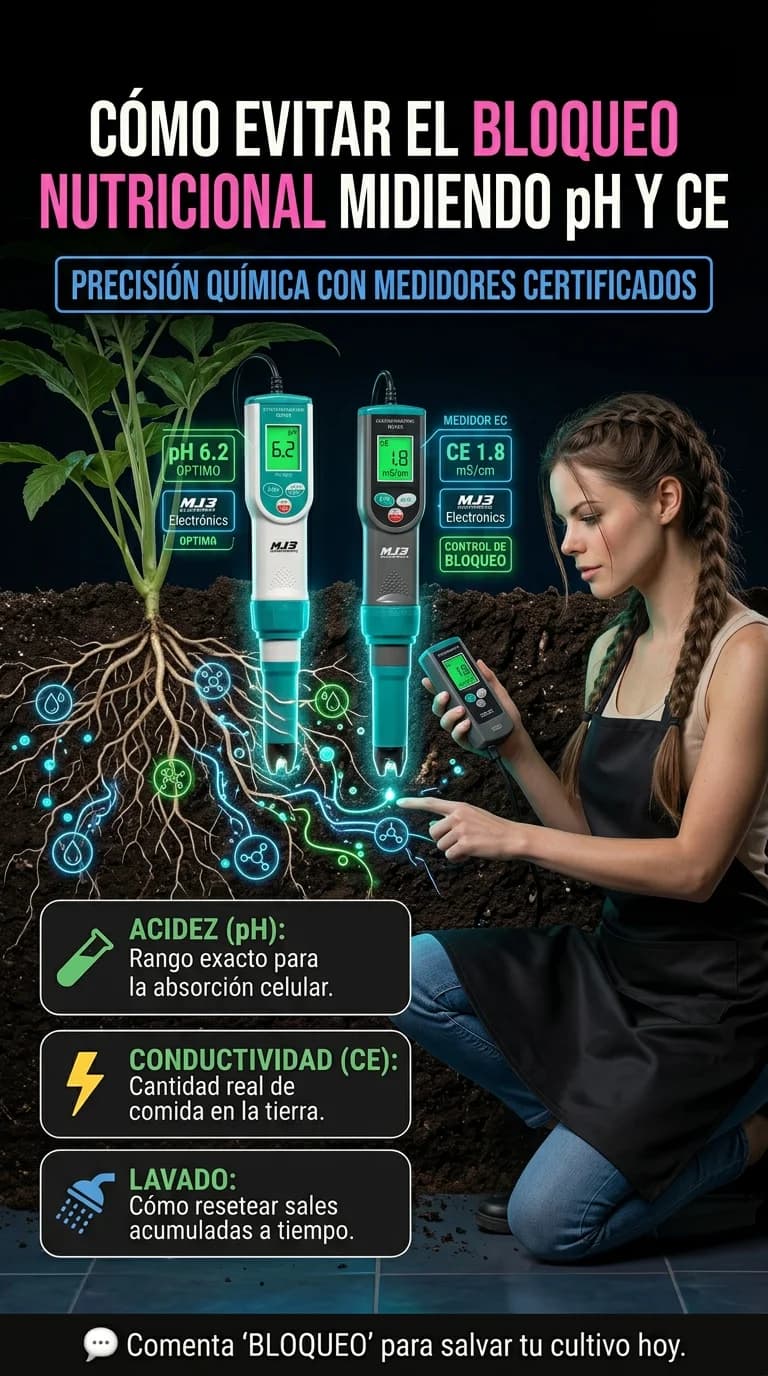
How to Read pH and EC in Substrate: A Practical Guide to Preventing Nutrient Lockouts in Indoor and Outdoor Growing

Ideal light and distance for each stage: How to avoid light stress and maximize photosynthesis with LED, HPS, and CMH