

How to Read Your Plant: Visual Diagnosis of Deficiencies and Excesses in Under 5 Minutes
The article teaches how to visually diagnose nutrient deficiencies and excesses in cannabis plants in under 5 minutes by dividing the foliage into three zones to identify specific problems based on nutrient mobility.
How to Read Your Plant: Visual Diagnosis of Deficiencies and Excesses in Under 5 Minutes
As a grower, your plant is constantly talking to you. Every leaf, stem, and flower emits visual signals that, if you know how to interpret, allow you to correct problems before they affect your harvest. In this article, you will learn how to perform an express visual diagnosis in under 5 minutes, based on the plant physiology and ontogeny of Cannabis sativa L.
The Quick Foliar Reading Map
For an effective diagnosis, divide the plant into three zones: upper leaves (new), middle leaves (mature), and lower leaves (old). Each zone reflects specific problems:
- Yellowish or spotted lower leaves: Indicate deficiencies of mobile nutrients (nitrogen, magnesium, potassium). The plant mobilizes these elements towards new growth.
- Deformed or chlorotic upper leaves: Signal deficiencies of immobile nutrients (iron, calcium, zinc) or salt excesses.
- Burnt tips: Classic symptom of excess fertilizer (salt burn) or water stress.
3-Step Diagnosis (Under 2 Minutes)
Step 1: Overall Color Assessment
Uniform yellowing from the bottom up → Nitrogen (N) deficiency. Solution: Increase the base fertilizer dose or apply [product:guia-de-nutrientes-organicos].
Yellowing between veins (interveinal chlorosis) in upper leaves → Iron (Fe) or manganese (Mn) deficiency. Common with high pH (alkaline soil). Adjust pH to 6.0-6.5 and apply chelates.
Dark green leaves with tips curled downward → Nitrogen excess. Reduce the fertilizer dose and increase ventilation.
Step 2: Check Spots and Patterns
Brown or necrotic spots on edges → Potassium (K) deficiency. Leaves appear burnt on the margins. Apply a flowering booster rich in K.
Yellow spots with brown dots → Magnesium (Mg) deficiency. Veins remain green. Correct with Epsom salts (magnesium sulfate) diluted in water.
Purple spots on stems and petioles → Phosphorus (P) deficiency or cold stress. Increase nighttime temperature and use a root stimulator.
Step 3: Inspect Deformations
"Eagle claw" leaves (curved downward) → Nitrogen excess or overwatering. Let the substrate dry out and reduce watering frequency.
Leaves curling upward → Heat stress (temperature >30°C) or light excess. Increase the distance of the lamps and improve air extraction.
Small and twisted leaves → Zinc (Zn) deficiency or calcium excess. Verify that the solution pH is between 5.8 and 6.2.
Excesses: The Silent Enemy
Excesses are more dangerous than deficiencies because they block the absorption of other nutrients. Key signs:
- Tip burn → General fertilizer excess. Flush the substrate with pH 6.0 water (3 times the pot volume).
- Thick and brittle leaves → Phosphorus excess. Reduce flowering fertilizer.
- Premature drop of lower leaves → Nitrogen excess or lack of oxygen in roots. Check drainage.
The 5-Minute Rule
- Minute 1: Observe the distribution of yellowing (bottom vs. top).
- Minute 2: Examine spot and edge patterns.
- Minute 3: Check for deformations and leaf texture.
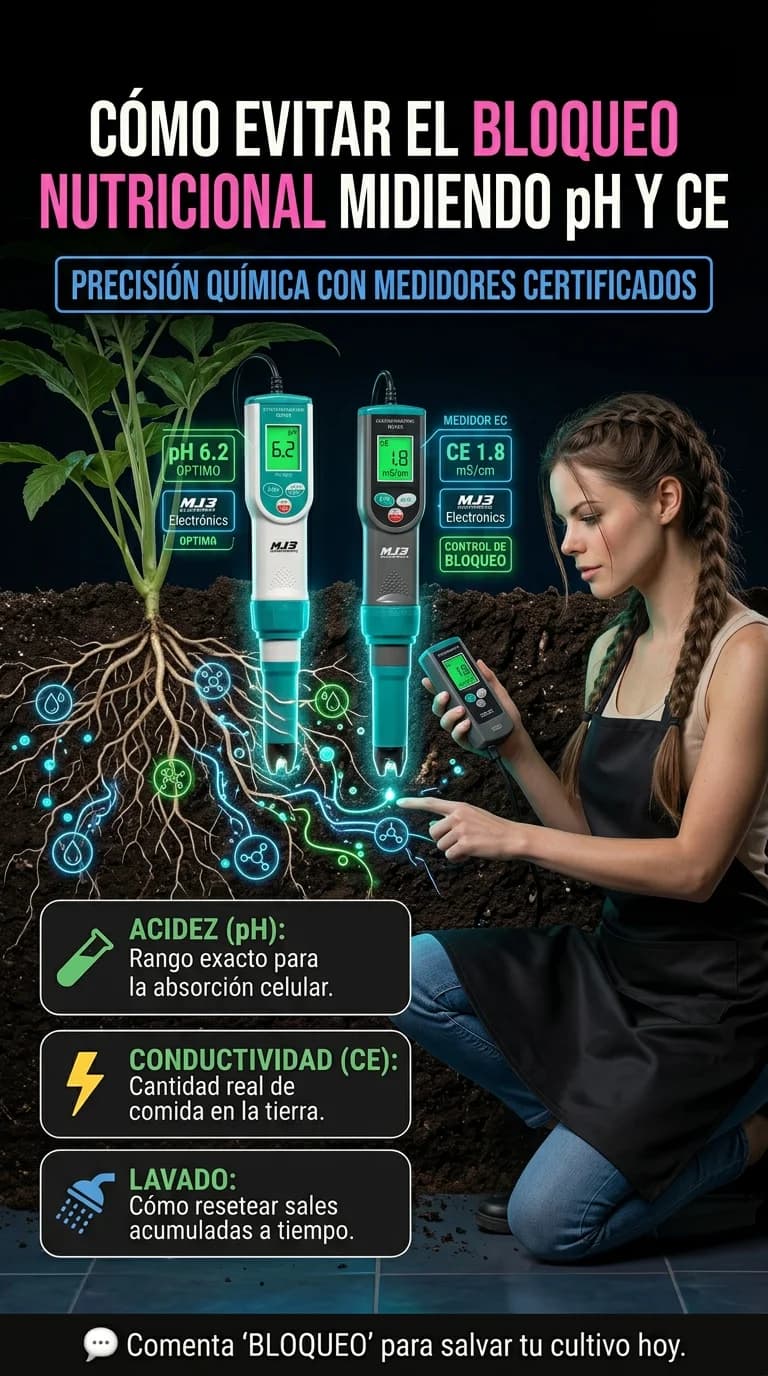
- Minute 4: Measure pH and EC of the irrigation solution (should be 5.8-6.2 and 1.2-1.8 mS/cm in veg, 1.8-2.4 in flower).
- Minute 5: Take a photo and compare it with a visual guide. If in doubt, act with moderation: it's better to under-correct than over-correct.
Conclusion
Reading your plant is a skill perfected with practice. Remember that Cannabis sativa L. is sensitive to sudden changes: any correction must be gradual. A quick visual diagnosis allows you to intervene within the first 24-48 hours, when damage is still reversible. If you need monitoring tools, consider a portable pH/EC meter or a well-draining substrate like [product:mezcla-de-sustrato-perlita]. Your plant will thank you with a vigorous and resinous harvest.
More articles

Complete guide to pH and EC in cannabis cultivation: How to calibrate, measure, and adjust without harming your plants
How to Read pH and EC in Substrate: A Practical Guide to Preventing Nutrient Lockouts in Indoor and Outdoor Growing

Ideal light and distance for each stage: How to avoid light stress and maximize photosynthesis with LED, HPS, and CMH