
How to Identify and Correct Calcium and Magnesium Deficiencies in Coco Coir Substrates
The article explains how to identify calcium and magnesium deficiencies in coconut substrates, caused by their low cation exchange capacity and tendency to retain sodium and potassium. It also offers solutions to correct these imbalances, especially in crops with LED lighting.
How to Identify and Correct Calcium and Magnesium Deficiencies in Coco Coir Substrates
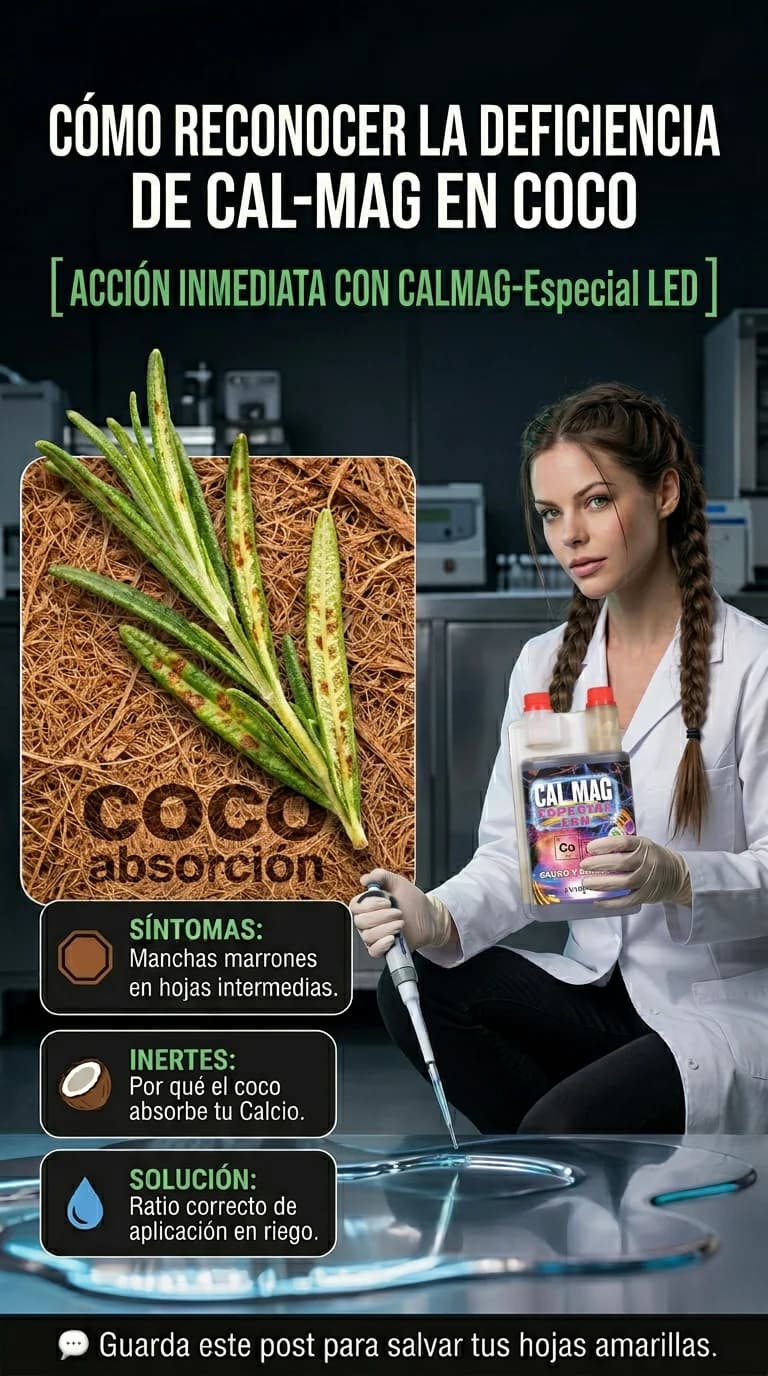
Growing in coco coir has become one of the favorite choices for modern growers, especially indoors with LED lighting. However, this inert substrate presents a particular challenge: its low cation exchange capacity makes calcium (Ca) and magnesium (Mg) especially difficult to maintain at optimal levels. In this article, you will learn how to detect deficiency symptoms and correct them effectively.
Why Does Coco Demand So Much Calcium and Magnesium?
Coco coir has a natural tendency to retain sodium and potassium, displacing calcium and magnesium from exchange sites. Additionally, when using high-power LED lighting, the plant increases its demand for magnesium for photosynthesis and calcium for cell division. If we add to this a starting water with low hardness or poorly managed EC, the result is deficiencies that hinder development.
According to reference data, EC (Electrical Conductivity) indicates the concentration of available salts. A very low EC can cause deficiencies, while a very high EC causes nutritional blockages. In coco, the ideal range is usually between 1.2 and 2.0 mS/cm during growth, and between 1.8 and 2.6 during flowering, always adjusting according to the phase and variety.
Visual Symptoms: How to Distinguish Calcium vs. Magnesium Deficiency
Calcium Deficiency
- New leaves: appear deformed, with curled-down edges and burnt tips.
- Stems and petioles: become weak and brittle.
- Roots: stunted growth, with brown tips or necrosis.
- Flowering: calyxes develop irregularly and flowers may show blossom end rot.
Magnesium Deficiency
- Old leaves: interveinal chlorosis (veins remain green while the rest turns yellow or orange).
- Spots: brown necrotic spots may appear between the veins.
- Premature drop: lower leaves fall off early.
- Yield: lower resin production and lighter buds.
How to Correct Deficiencies Step by Step
1. Adjust the Irrigation pH
The ideal pH for coco cultivation is between 5.8 and 6.2. Outside this range, calcium and magnesium become locked out even if present in the solution. Always measure after adding nutrients.
2. Check EC and Ca:Mg Ratio
A balanced ratio is key. In coco, a 3:1 or 4:1 (Ca:Mg) ratio is recommended. If you use very soft water (EC < 0.3), you will need to supply both elements from the start.
3. Use a Specific LED Corrector
Crops under LED have increased calcium and magnesium needs. [producto:cal-mag-especial-led-1-l] is formulated precisely to cover this deficit, providing both elements in chelated form for rapid assimilation. Apply from the first week of growth until the final flush, following recommended dosages (generally 0.5-1 ml/L).
4. If the Problem Is Widespread, Opt for a Total Corrector
Sometimes Ca/Mg deficiency comes with other imbalances (iron, zinc, phosphorus). In that case, [producto:anarkia81-corrector-total-todo-en-uno-1-l] acts as a "nutritional insurance," correcting chlorosis, stress, and blockages. It is especially useful after transplanting or after a heat stress spike.
5. Ensure Adequate Base Nutrition
If you work with a two-part system, like [producto:anarkia81-coco-a-5-litros], remember that part A usually contains calcium and part B contains sulfates and phosphates. Never mix concentrated A and B, as they would precipitate calcium. Always dilute part A first in water, stir, then add part B.
Prevention: Consistency Is Key
- Measure drain EC: if the output EC is lower than the input EC, the plant is absorbing well. If it is higher, there is salt buildup and risk of blockage.
- Add Cal-Mag from the start: don't wait to see symptoms. In coco, it is better to prevent with low doses (0.3-0.5 ml/L) throughout the cycle.
- Control solution temperature: below 18 °C, phosphorus and calcium absorption slows down; above 26 °C, transpiration and magnesium demand increase.
Conclusion
Identifying a calcium or magnesium deficiency in coco coir substrate in time can save your harvest. Observe new leaves for calcium and old leaves for magnesium, adjust pH between 5.8 and 6.2, and don't skimp on a specific corrector like [producto:cal-mag-especial-led-1-l] or a total corrector like [producto:anarkia81-corrector-total-todo-en-uno-5-l] if the problem is complex.
More articles

Complete guide to pH and EC in cannabis cultivation: How to calibrate, measure, and adjust without harming your plants

How to Read pH and EC in Substrate: A Practical Guide to Preventing Nutrient Lockouts in Indoor and Outdoor Growing

Ideal light and distance for each stage: How to avoid light stress and maximize photosynthesis with LED, HPS, and CMH