
How to Avoid Light Stress in Your Indoor Grow: Common Mistakes with LEDs and HPS
Light stress in indoor crops occurs when plants receive excessive light intensity or an inadequate spectrum, reducing yields and potentially bleaching buds. To avoid it, it is crucial to identify common mistakes with LEDs and HPS, such as incorrect distance or excessive power, and adjust lighting according to plant needs.
How to Avoid Light Stress in Your Indoor Grow: Common Mistakes with LEDs and HPS
Lighting is the engine of photosynthesis and, therefore, the most determining factor in the productivity of an indoor grow. However, an excess or poor management of light can trigger light stress, a silent problem that reduces yields, alters plant morphology, and can even "bleach" buds. In this article, we will analyze the most frequent mistakes with LED and HPS (sodium) fixtures and how to avoid them to maximize the health and production of your plants.
What is Light Stress and How to Detect It?
Light stress occurs when the plant receives a light intensity (PPFD) higher than its photosynthetic assimilation capacity, or when the light spectrum is not suitable for the phenological phase. Cannabis plants, especially during the flowering phase, have a light saturation limit that, if exceeded, causes photoinhibition.
Key Visual Symptoms:
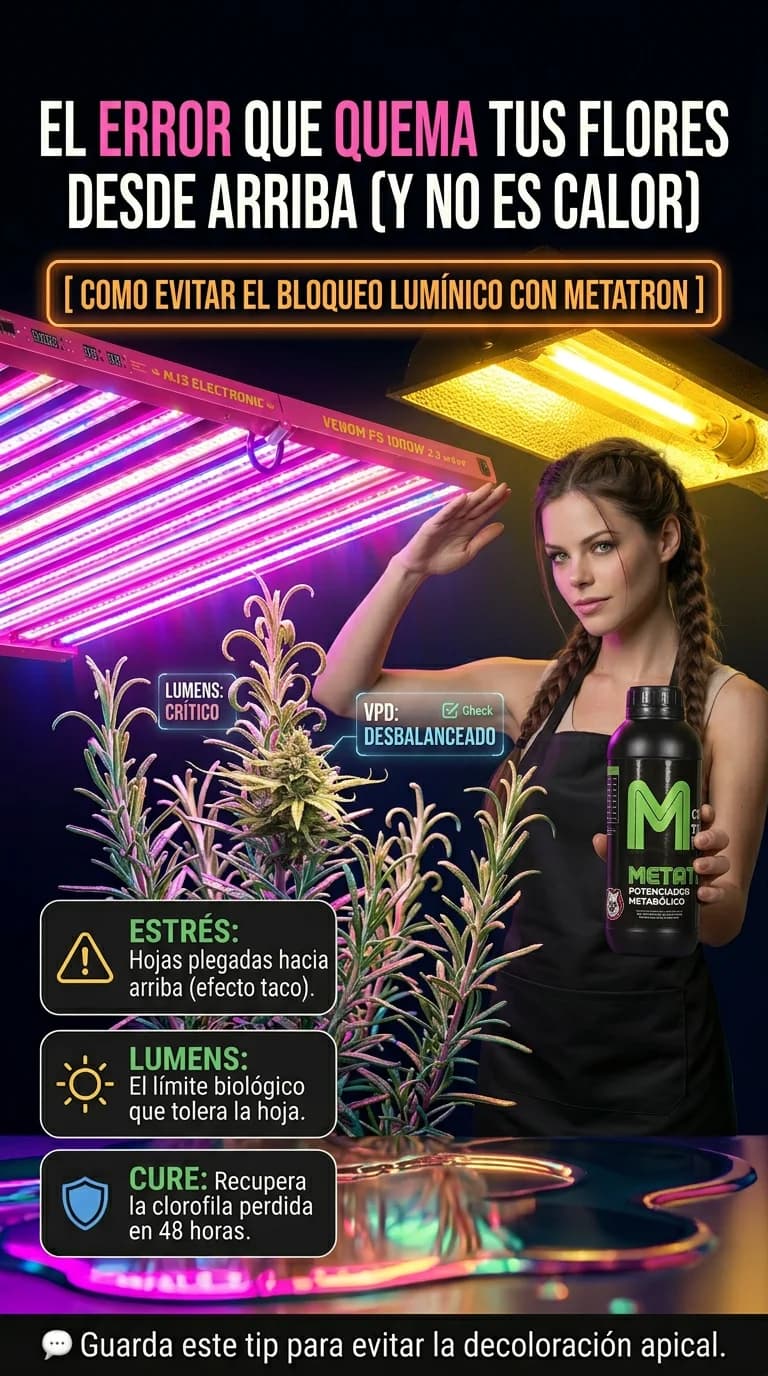
- Yellowish upper leaves or with "burned" edges (apical chlorosis).
- Whitish or brown bud tips (bleaching).
- Leaves curling upwards (like an inverted "V").
- Premature leaf drop in the upper canopy.
These signs are often confused with nutritional deficiencies. In fact, a relevant piece of data from our knowledge base is that EC (Electrical Conductivity) measures the concentration of salts in the irrigation water. A very high EC can cause over-fertilization and root burn, but if light stress is also present, the problems are compounded: damaged roots cannot absorb water or nutrients to compensate for the transpiration forced by intense light.
Mistake #1: Incorrect Distance of the Fixture
The most common mistake with both LEDs and HPS is placing the lamp too close. Light intensity follows the inverse square law: by halving the distance, the intensity quadruples.
With LEDs: Modern LEDs (especially full-spectrum ones with high µmol/J efficiency) are deceptive. Since they don't emit as much radiant heat as HPS, growers tend to place them too close, thinking they "don't burn." However, the PAR (Photosynthetically Active Radiation) can be overwhelming. For plants in flowering, a safe distance with high-power LEDs is usually between 30-45 cm, depending on the model and stage. If you observe the mentioned symptoms, raise the light 10-15 cm immediately.
With HPS: HPS lamps generate a lot of infrared heat, which raises leaf temperature. Placing them less than 40-50 cm away can cause combined thermal and light stress. A [product:kit-de-sodio-720w-electronico-mj3] 720W kit, for example, must be handled with care: although it is dimmable, it should not be used at maximum power without an adequate safety distance (minimum 50-60 cm in flowering).
Solution: Use a PPFD meter (like a quantum sensor) or apply the back-of-the-hand rule: if you feel uncomfortable heat at canopy level, your plants are suffering too.
Mistake #2: Ignoring the Spectrum and Phenological Phase
Not all light is suitable for all stages. A frequent mistake is using the same spectrum from cuttings to harvest.
In Vegetative: Plants need a spectrum rich in blue (400-500 nm) to avoid excessive stretching and promote robustness. LEDs with too much red in this phase can cause long internodes and weak plants, increasing the risk of stress by not having enough structure to support the light.
In Flowering: Far-red (730 nm) and deep red (660 nm) spectra are crucial for inducing flowering and increasing biomass. But an excess of red without enough blue can saturate photosystem II, generating light stress even at medium intensities. The solution is to combine spectral channels well or use fixtures specifically designed for cannabis.
Mistake #3: Not Adjusting Intensity Progressively
The "all or nothing" mistake is lethal. Going from 300 µmol/m²/s to 900 µmol/m²/s in one day is a recipe for stress. Plants need acclimatization, just like we do to the sun after winter.
- Practical Rule: Increase light intensity by 10-15% every 2-3 days during the first week of flowering.
- With Dimmable HPS: Take advantage of the dimming function. For example, a [product:kit-de-sodio-720w-electronico-mj3] allows adjusting power from 250W to 720W. Start at 400W, and gradually increase to 600W or 720W as the plants adapt.
- With LEDs: If your driver is dimmable, use it. If not, raise the lamp during the first few days and then lower it slowly.
Mistake #4: Imbalance Between Light, CO2, and Nutrients
Intense light demands a balanced ecosystem. If you increase light but not CO2 (ideally 1200-1500 ppm in flowering), plants cannot photosynthesize efficiently and become stressed.
More articles
Complete guide to pH and EC in cannabis cultivation: How to calibrate, measure, and adjust without harming your plants
How to Read pH and EC in Substrate: A Practical Guide to Preventing Nutrient Lockouts in Indoor and Outdoor Growing
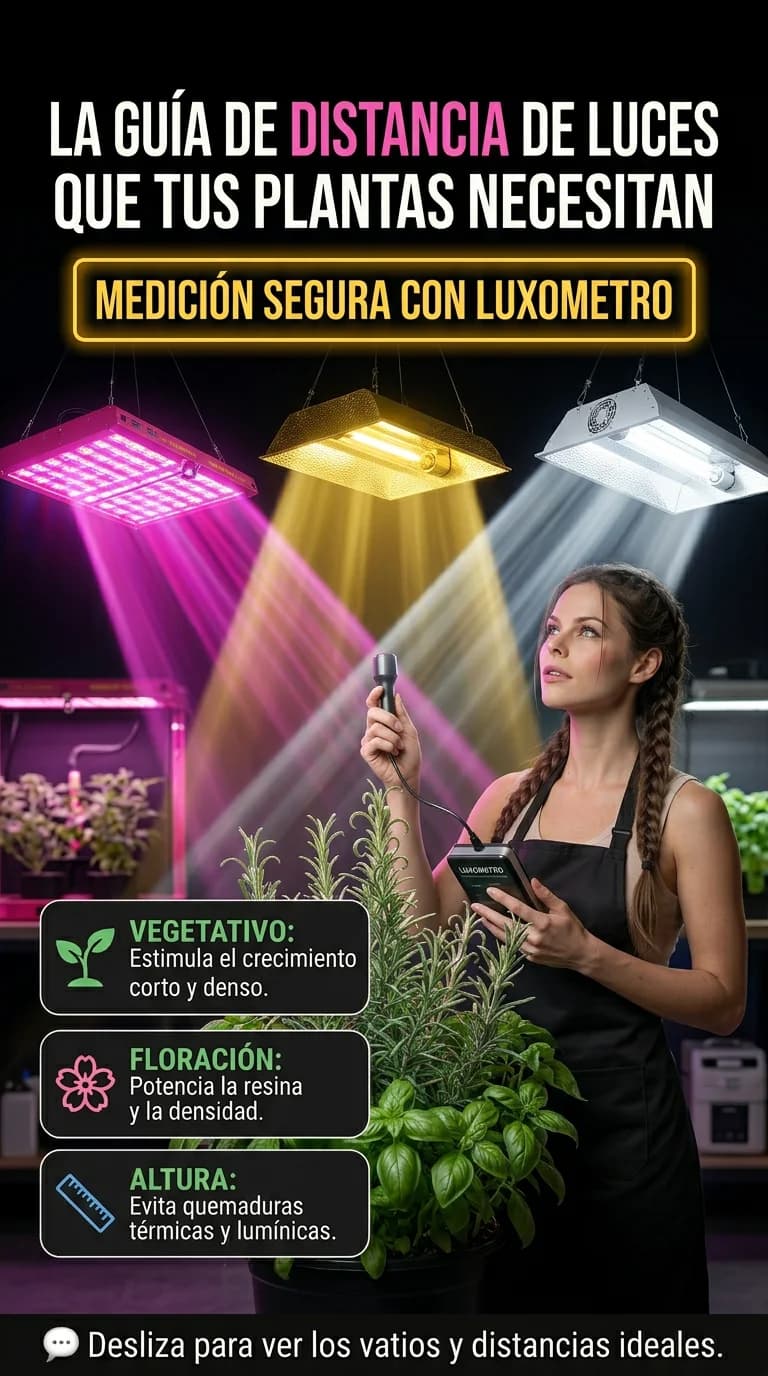
Ideal light and distance for each stage: How to avoid light stress and maximize photosynthesis with LED, HPS, and CMH